october, 2019
more
Event Details
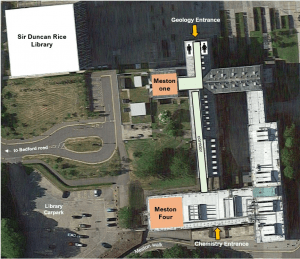
*Please note change of room to Meston 4 for the first talk only, thereafter back to Meston 1 as usual (please see map below).
Abstract:
Hugh Miller’s collection and work on fossil fish from the Devonian of Scotland in the mid 19th century has been an inspiration for many palaeoicthyologists since his time. Importantly, the work of Agassiz, Huxley and Traquair was heavily dependent on that of Miller. Many people working on fossil fish from Scotland have come and gone since Miller’s time though a recent resurgence in finds from the Carboniferous rather than the Devonian have again placed Scotland on the map as a world-class location for fossils recording evolution across the important water-land transition.
I will present some of the recent finds from the Carboniferous of the Midland Valley of Scotland that have caused us to reassess our understanding of the evolution of vertebrates across the Devonian-Carboniferous boundary. I will also highlight the importance of continuing work on the famous Devonian sites of Caithness from recent work on the brain structure of the well-known fish from the Orcadian basin but more importantly the new techniques we can apply to understand the sensory systems of these long-extinct animals.
Finally, new finds from the Jurassic deposits of the Isle of Skye and Sutherland will be presented demonstrating that Scotland has a great deal more to offer with regards fossil fish than the historical Devonian and Carboniferous site.

Tom researches ancient fish species during the vertebrate transition from water to land and the evolution of thier sensory functions. Using micro-CT to x-ray the brain cavity, nerve and blood vessel canals in fossilised fish skulls to reveal exciting new data on the evolution of senses (sight, smell, hearing) during this important period of vertebrate evolution.
Tom did his undergraduate in Geology at the University of Edinburgh followed by an MSc in Paleobiology in Bristol and a PhD in Durham. Having worked as a research geologist for Total E&P UK, Tom switched his research interests to fossil fish taking up a post as a researcher at University of Edinburgh School of Geoscience. Fieldwork has taken him to the US, Arctic but mostly Scotland due to the “amazing array of sites right on our doorstep”.
Map showing the location of Meston 4: